

2·
5 days agoI believe that has been your personal experience, but that’s not the case for everyone. Addiction isn’t rational, and alcoholism wears a lot of costumes.
I believe that has been your personal experience, but that’s not the case for everyone. Addiction isn’t rational, and alcoholism wears a lot of costumes.
Sometimes alcohol abuse is just addiction. Trauma soon follows, though.

There’s a kryptonite fog binding ritual covering Metropolis the Northern Kingdoms. Race through rings to unlock additional powers.

It shouldn’t be that easy to eradicate an insect. This feels like “Good news, you don’t have to worry about laundry now that the fire has consumed your house.”

Well it technically works…
Nope. There’s your problem. You don’t start with any version of “it works.” You begin with “here’s how the old system is costing us money, and here’s how much more money the new system will increase profits.” Tech debt is the catchphrase of the moment, and you can describe it in financial terms executives understand. Tech debt charges interest, and the interes of delaying payments into infrastructure will outpace the money saved by a significant margin. That’s why spending the money now will decrease friction, reduce churn, and streamline onboarding of new accounts. This is what our competitors are doing, and this is how we can do it better.
That’s the pitch. If your argument is “it works, but we can do better,” that makes it sound like you’re putting extra padding in the first class seats. The real answer is it works because IT is working in a constant state of panic and the job of 10 engineers is being done by two interns and a roll of duct tape. To an executive, that sounds like efficiency, because they don’t give a shit about you. Number goes up, that’s their focus.

You are different by your skin color. People are all literally different colors. And because racism exists, that affects every aspect of your existence from the moment you’re born. You cannot overcome racism by saying “let’s just all pretend we’re all the same.”
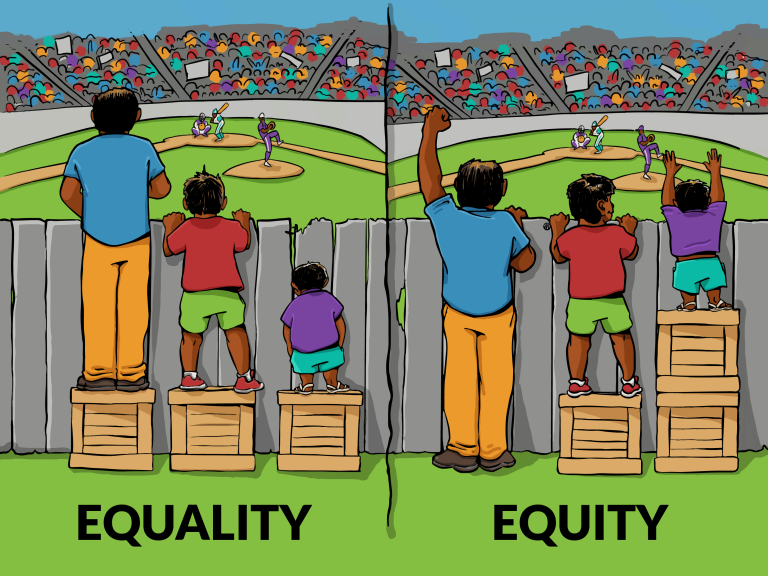
Set race aside for a minute, because I think you’re trying too hard to be un-racist. Consider height for a bit. Everyone is a different height. It doesn’t make you a good or bad person to be tall or short. Certain things are easier or harder, and people at each height bracket have similar experiences. People also face discrimination based on their height. It is discriminatory to make assumptions about a person’s qualities based on their height, but it is not discrimination to identify people as taller, shorter, or average height. Pretending height difference don’t exist will not counteract height discrimination, and in fact will foster attitudes that do not account for individual differences.
But being black or white is part of who they are. By ignoring their race, you are in fact devaluing who they are as a person. Black and white are different. Not better, not worse, and not limited to preconceived definitions.
It’s like the Stephen Colbert bit where he pretended he couldn’t see color. It was humorous because he acted like it made him anti-racist, but actually it was extremely racist. Your original point is the sort of well-meaning pandering naivete he was satirizing.
I’m not confused about what racism is. You’re the one saying people who disagree with you are supporting racism.
Your definition of “racism” is limited to disagreeing with you.
So we stop it by pretending it doesn’t happen? Act like nobody experiences discrimination, and they won’t? Forgive me, but that’s incomprehensible logic.
Racism isn’t acknowledging differences, it’s demanding them. And demanding we treat everyone the same ignores the reality that different races live. We stop racism by celebrating our differences and learning from each other so that we might be more open to each other. To pretend we’re all the same is to ignore that which makes us special, and it is racism to expect the same from everyone regardless of their life experiences.
I’m not sure who you mean by “you people” but that sounds kind of racist.
No but seriously, I don’t think it’s racist at all to describe shared experiences, as long as you don’t presume to know someone’s life experiences by the color of their skin. For instance, a lot of black people experience police discrimination in America. Being pulled over for no reason, needing to stay calm and respectful in the face of fascism, these are normal, common experiences that can traumatize a person. Talking about those experiences with people who have lived them can help you process and heal from the trauma.
A white person can also be pulled over by police for no reason. It could be because of the way they look. They may have been afraid that the police would randomly decide to murder them in broad daylight. This experience can happen to anyone, but because it disproportionately happens to black people, they are able to discuss it in short hand. “You been pulled over?” “Yeah, DWB. Motherfuckers.”
Two white people would not have the same conversation. “I got pulled over.” “Speeding?” “No, no reason at all.” “That happened to me once. Broken tailight, the cop was really nice about it.” “No, man, like he seemed angry and suspicious, and I thought he was going to arrest me or shoot me or something.” “For real?! That’s wild. You should call a lawyer and sue his ass.”
It’s not racist to describe these two realities. It’s not racist to ask about these experiences to learn from other cultures. It is racist to assume that these experiences are universal. You couldn’t say for sure that these are the experiences of a particular individual based on their race.
I had a neighbor who worked on cars in his driveway. Several neighborhood cats died before people realized what was going on. This was back in the 90s, though, and I don’t see so many outdoor cats nowadays.
Exactly this. If you need to step away, take care of something, or just need a break, that ought to be entirely acceptable.
The reason it seems like parents “get away with it” is because they push limits, because they have a priority higher than anything else related to employment. I have to go get those kids. Is that report urgent? Cool, I’ll get to it as soon as the literal humans whose lives are depending on me for basic survival are safe at home. Are you going to fire me for parenting? Because that doesn’t change my priorities.

I kind of love it, and it’s working pretty well except for the bed. I should just replace the bed surface and put it in an enclosure, or I should upgrade to a newer printer entirely.
I inherited an older Delta printer that had a warped, janky bed and damaged nozzle from poor calibration. Even after replacing damaged parts and recalibration, I still need to print rafts for everything. That first layer is everything, and the tutorials for getting an even first layer have been immensely helpful in my journey.
Coolant leaks kill a lot of pets and strays. It sounds like OP’s story was intentional, but it does happen by accident.
Is this a serious question? How much poop was in the underwear? Anything looks brown because it’s covered in poop, then wash it again. In fact, wash the whole load again (without a load of poop).
If you’re serious, and one of your socks looks faded or bleached, but is clean, then you do have some options. This didn’t happen because there was a skidmark in your underwear, though. It’s most likely bleached, which can be caused by the sun, or some other chemicals on your sock (assuming you didn’t put bleach in with your dark clothes). It could also have been residual bleach from the last wash. You’ll want to figure out why it happened so it doesn’t happen again.
For a bleached sock, your best bet is probably re-dying the sock. Get some black dye (which is uaully a really dark blue or brown, actual black is tricky) that is specifically made for cotton/poly blend. Pure polyester needs special dye at high temps to take it in, so be prepared for mixed results.
Another option is to bleach the other sock to match. This is tricky, because it will be tough to match the lightness, and you risk ruining the socks since the bleach dissolves the fabric a little. And then your socks look poopy, as Jamie Tartt would say.
Option 3 is to just wear the socks. It sounds like you’re describing an athletic sock, and if you’re playing a sport in shorts, who cares if one sock looks weird? If you’re wearing long pants, people aren’t likely to see or care about your socks.
If it’s part of a uniform where it matters that you’re wearing black socks, go ahead and buy another pair. Keep the bleached one to polish your shoes, and then you’ll have three black socks in your laundry in case you lose one to the sock goblins that live in the dryer.

Current, but he’s a retired Marine chiropractor and guru.
Because an uncaring or immoral god is unworthy of praise or devotion. Why donate your life or your fortune to a god that created the universe and then fucked off?