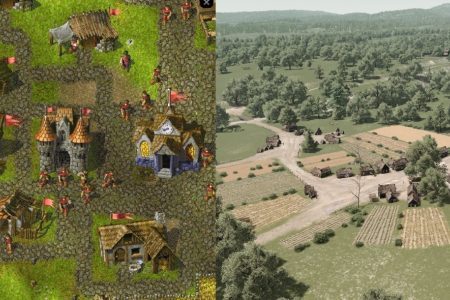
Medieval towns were planned almost in their entirety before anyone moved there, they followed some set standards on what to build, and once established they remained mostly unchanged in size or population. As opposed to games, where you place a city center and organically grow out from there in a linear fashion in both terms of buildings and population.
Here in central europe, it worked like you’d imagine: Lot’s of “grouped farms”, hamlets, 100-people castle villages, bigger villages, local-center-villages, small towns. All maybe one or two miles apart.
And some tidbits from history; how the local district was sold to the Habsburgs, because the next bigger city had debts (the Habsburgs didn’t keep it either). Or how the local small city got city rights back in 1700, despite only being a small town, because it was strategically important.
And while the bigger cities were around since the romans, it all grew organically.
This doesn’t match at all with what you’re saying.
Nah, I’m being snarky. It’s a comparison of a couple of games (like Settlers and Banished) to what’s actually known about life in medieval times. Notable differences are that in reality people didn’t have much to eat, also due to tithes by the church, whereas in games your entire goal is achieving huge (food) surpluses.
Also, in games you often build a town center and then start building further buildings quite organically, whereas in actuality towns were planned based on the surroundings.
The article is actually pretty interesting, not at all ‘stop having fun’ as another commenter’s meme here is saying. Though it doesn’t discuss Manor Lords.


TL;DR?
Medieval towns were planned almost in their entirety before anyone moved there, they followed some set standards on what to build, and once established they remained mostly unchanged in size or population. As opposed to games, where you place a city center and organically grow out from there in a linear fashion in both terms of buildings and population.
Where, Balkan, US?
Here in central europe, it worked like you’d imagine: Lot’s of “grouped farms”, hamlets, 100-people castle villages, bigger villages, local-center-villages, small towns. All maybe one or two miles apart.
And some tidbits from history; how the local district was sold to the Habsburgs, because the next bigger city had debts (the Habsburgs didn’t keep it either). Or how the local small city got city rights back in 1700, despite only being a small town, because it was strategically important.
And while the bigger cities were around since the romans, it all grew organically.
This doesn’t match at all with what you’re saying.
Curvy roads better than straight roads.
Thanks! But haha, that’s it? That’s the main critique?
Nah, I’m being snarky. It’s a comparison of a couple of games (like Settlers and Banished) to what’s actually known about life in medieval times. Notable differences are that in reality people didn’t have much to eat, also due to tithes by the church, whereas in games your entire goal is achieving huge (food) surpluses.
Also, in games you often build a town center and then start building further buildings quite organically, whereas in actuality towns were planned based on the surroundings.
The article is actually pretty interesting, not at all ‘stop having fun’ as another commenter’s meme here is saying. Though it doesn’t discuss Manor Lords.
Nou, bedankt!
Haha, a bit of truth balanced by a bit of cynicism, one supposes…? XD
Shit, I need to get off my arse…
https://piefed.social/c/eurographicnovels?tag=dutch
There are europen towns that are young enough to have been planned?